
"I jump into a sand pit for a living"
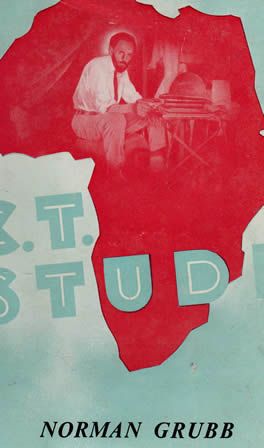
CT Studd Cricketer and Pioneer
Return to the book list for this category.
by Norman Grubb, Lutterworth, 1970
CT Studd was probably the first evangelical Christian to play international sport in the UK. As such a book on his life is of great interest. The major weakness in the book is that it is written by Studd's son-in-law and the book could in no way be described as unbiased!
The book traces the story of Studd's privileged upbringing - Eton and Cambridge, his sporting prowess, his conversion to Christianity and his missionary service in China, India and Africa. Studd was without question an extremist whose life involved no holidays, no recreation, complete absorption into the one task of proclaiming the gospel. He believed he was called by God to leave his wife and children behind and spend the last 20 years of his life in Africa. [Page 234]. The leaving of his wife - whose health would not permit her to come to Africa - is presented factually and uncritically.
As a player he had immense talent, playing for England against Australia in both countries. It is impossible to judge just how good he was as he quit international cricket before he had reached his peak. Years later when in India (1900-1906), he joined a cricket tour in order to get opportunities of holding meetings with soldiers at night after they played the regimental teams. His form returned to him and in1904 he made two double centuries, a feat which had only been performed once previously in Indian cricket.
The book gives us some insights into how Studd viewed cricket, "..when the cricket season came round. I thought I must go into the cricket field and get the men there to know the Lord Jesus. Formerly I had as much love for cricket as any man could have but when the Lord Jesus came into my heart I found that I had something infinitely better than cricket. My heart was no longer in the game; I wanted to win souls for the Lord. I knew that cricket would not last and honour would not last and nothing in the world would last but it was worth while living for the world to come". [Page 33/34]
or
"I do not say don't play games and cricket and so forth. By all means play and enjoy them, giving thanks to Jesus for them. Only take care that games do not become an idol to you as they did to me. What good will it do to anyone in the next world to have been the best player that ever has been? And then think of the difference between that and winning souls for Jesus." [Page 57]
While he gave up playing cricket for the cause of the gospel, cricket clearly remained part of him. He often used cricketing language to describe ministry: "I spoke with all the gusto of making a century at cricket against the Australians" [Page 114] or when he did not have a chance to pray in a prayer meeting he protested "before I could have my innings, the leader had pronounced the benediction!" [Page 176]
Urging others to be more adventurous in ministry, he spoke of the need to "go in for a slog. Your eye is in all right and the bowling is getting weak. Take the long handle, only a few minutes to the stumps are drawn". [Page 210]
Authors like Putney and Ladd and Mathisen portray Studd as spreading Muscular Christianity in the USA. However Grubb's book describes his speaking trips on American campuses only in terms of evangelizing students, with no reference to a sporting context. Perhaps his contribution to a Muscular Christian movement has been exaggerated. [Pages100-115]
As an account of how a pioneer Christian in top-level sport conducted himself, the book is of value. However, the book gives us little evidence of Studd having any concept of Muscular Christianity or an interface between sport and Christianity.